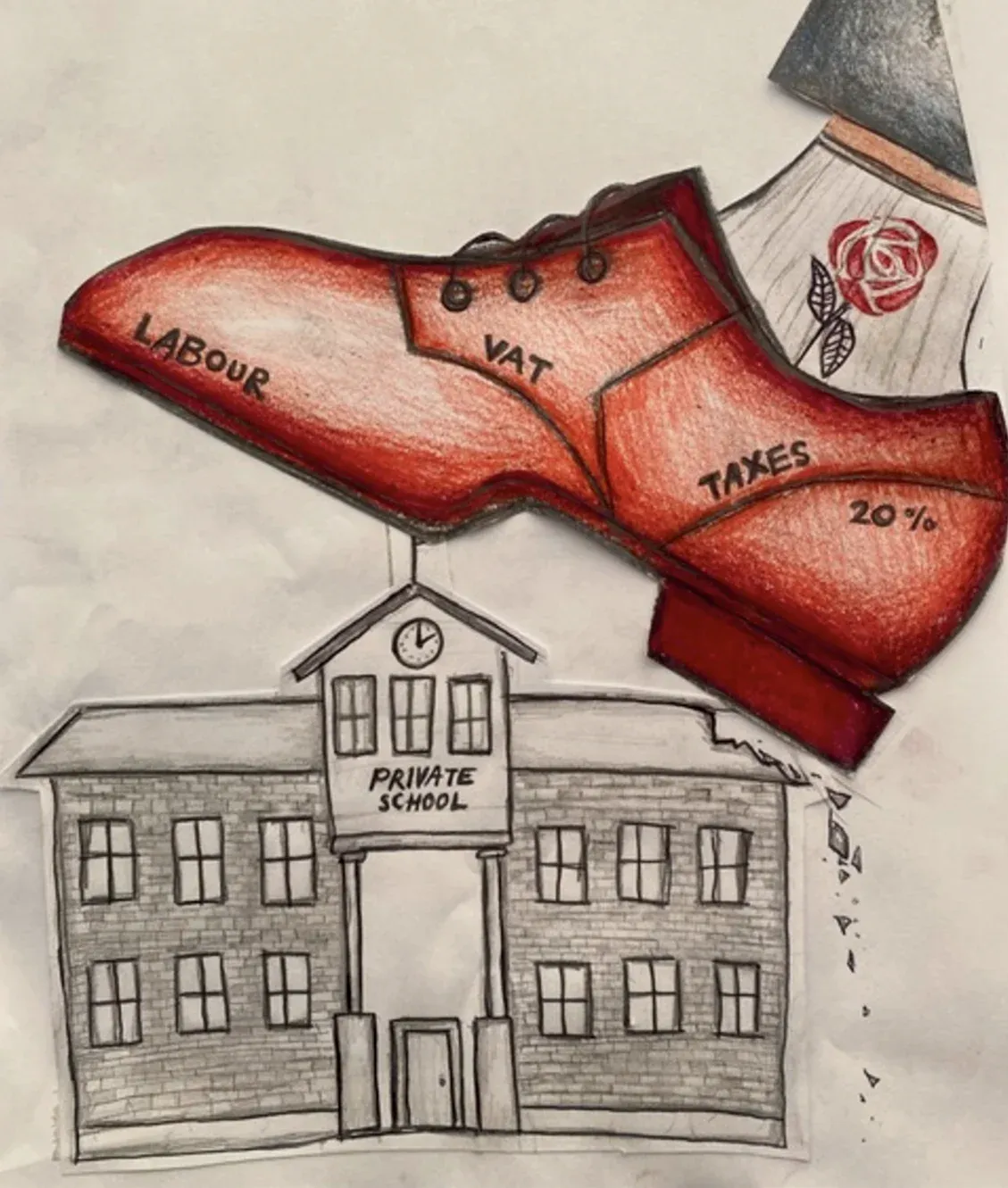
When Education Becomes a Tax Policy
Daniel Combi, LVI, looks at the effects of taxation on private education and wonders - has the VAT implementation done more harm than good?

Daniel Combi
Digital Editor
Artwork by Holly Lambert
Senior 8
For the past year, education in the UK has been officially taxed like any other product. The removal of the VAT exemption on private school fees marked a key shift in how the government views private education with it not as a protected public good but as a taxable service. Many in favour have welcomed the move as a step towards fairness for every child whilst critics have warned it would harm families and pupils rather than the institutions themselves.
The case for taxation is primarily equity. Private schools have historically benefited from a generous tax exemption despite charging rising fees that exceed average household incomes. Meanwhile, state schools continue to suffer from a lack of funding, rising class sizes and major staff shortages.
By taxing private schools, the government believes that it is removing an unjustified privilege (6% of the population) whilst raising revenue that can be put into the state system. This can potentially reduce educational inequalities. Supporters argue that this is not about punishing success, but about redistributing resources in a way that benefits the majority and strengthens the overall system.
Yet the consequences have been proven to be quite complex. Many families using private schools are not extremely wealthy, and the additional 20% cost has resulted in around 15,000 private school students transferring to the state sector. This risks putting increased pressure on an already stretched system and raises concerns for specialist schools that focus on supporting pupils with special educational needs.
In these cases, the policy may have unintended effects, shifting strain rather than solving underlying issues. Here, taxation doesn’t build the state but rather undermines it, highlighting how policies designed with one purpose can generate outcomes that contradict it.
The additional 20% cost has resulted in around 15,000 private school students transferring to the state sector.
There is also a broader economic question at play. When a service closely linked to opportunity is taxed, it changes behaviour. Some families may withdraw from private education altogether while others may make significant financial sacrifices to remain. Schools themselves may respond by cutting costs, reducing bursaries or altering the facilities they provide. None of these responses necessarily align with improving educational quality or access. Instead, they reveal how policy can reshape incentives in ways that are difficult to predict and even harder to control.
The policy exposes the flaws of both systems. While independent schools offer unparalleled advantages which some consider unfair and unjust, state schools are poorly funded and overstretched through no fault of their own. Taxing private education, like any other publicly beneficial service, may seem like a needed fix but it might just result in greater pressure on state schools and fewer choices for families. The policy risks treating the symptom rather than the root cause. This symbolises that inequality in education runs much deeper than school fees alone with it rooted in long-term funding gaps, regional disparities and differences in access to support and resources.
This raises the central question of purpose. If the aim of VAT was to create a fairer education system, its success will ultimately depend on its results, not intentions. Education should exist to expand opportunity rather than become another battleground for political virtue signalling and we must ask ourselves whether we are truly serving that purpose. Ultimately, a policy’s value lies not in how it is presented but in whether it meaningfully improves outcomes for students across all backgrounds.