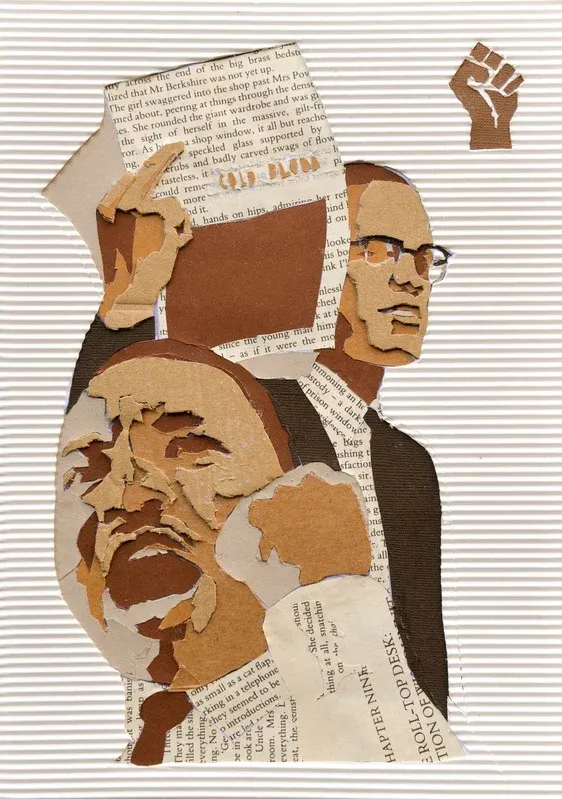
Peers in Protest - Martin Luther King and Malcolm X
History & Politics Editor Jack Smith, LVI, explores the complex relationship between Martin Luther King Jr. and Malcolm X with their different visions of equality and justice.

Jack Smith
History & Politics Editor, 2026

Artwork by Ruby Hellier
Art Director, 2026
In the 1960s and 70s, equality was a tantalising prospect for many African Americans. In a time of prevalent Jim Crow* laws (*mandated segregation), forever filibustering senators and hooded Ku Klux Klansmen, the Civil Rights Movement emerged. Broadly speaking, two men - Malcolm X and Martin Luther King - characterised this movement, vying for freedom in an unequal world. Yet too often are they grouped under the umbrella of ‘freedom fighters’, as spearheads of this momentous movement.
Conversely, within their complex relationship, they are too often portrayed as antagonists, pitted against each other as radical opponents who fractured this mainstream collective. As a result, a dilemma has emerged. A dilemma that fails to provide a clear picture of two of the most significant activists of their time.
Martin Luther King grew up in a middle-class family, in Atlanta, where his father and grandfather were Baptist preachers. He received education at Morehouse College in Atalanta, where he was admitted due to his promising academic ability. Following his time at college, he went to Crozer Theological Seminary in Chester and later to Boston University King followed the footsteps of his father, entering the ministry and working as the pastor of the Dexter Avenue Baptist Church in Montgomery.
Malcolm X, on the other hand, grew up in starkly different conditions to King. Born in Omaha, Nebraska to Rev. Earl Little, a Baptist minister, Malcolm X experienced a tumultuous childhood. At the age of 6, his father died in a streetcar accident (possibly at the hands of white supremacists), with his mother being committed to an insane asylum when he was a teenager. His intellectual capabilities were attracted by rebellion, as he led a gang of thieves in Roxbury and Harlem, earning him the nickname: “Detroit Red”.
Their upbringings couldn’t have been more contrasting, yet their experiences led them down a path of activism. King’s summer spent on a tobacco farm in Connecticut heightened his feelings of hatred towards racial segregation, as he observed the peaceful mix of races in the North. Furthermore, at Morehouse, Kings mentor Benjamin Mays fermented feelings of dissatisfaction towards the complacency of African Americans in the face of persecution. Meanwhile, during his time in prison for various crimes, Malcolm X converted to Islam, leading to his integration into the Nation of Islam movement, an organization led by Elijah Muhammad. This movement focused upon Black superiority and creating a separate Black nation.
Both emerged to become charismatic, articulate and distinguished leaders of two respectively different branches of the Civil Rights Movement.
Malcolm X did champion Black superiority, alongside violent and confrontive action - which sharply contrasted to the peaceful and considerate non-violent methods that Martin Luther King swore by.
Yet, when considering their goal, it was to eradicate preconceived notions surrounding African Americans; those deeply ingrained ideas of white supremacy and inequality. This integral aim interconnected these two figures, despite the schism in their approach to the means of achieving this end.
Consequently, it can be easy to make shallow assumptions about their antagonism or indeed their cohesion. It is imperative that their autonomy and integrity is considered, without blending them into one mismatched image of those that strived for freedom. Their purpose is often misinterpreted, yet they took parallel paths that ultimately aligned with each other, despite their drastically different methods.
Despite attempts to silence these men, most notably through their respective assassinations, their crucial values and ideologies speak loud and clear in the modern day. Therefore, it is vital that they are distinguished and defined properly, so long as their legacies remain woven in the fabric of Black History.
Though their ideologies differed, what they strove for integrated their personal values into society, their purposes leaving a seismic and lasting imprint on the state of equality today.