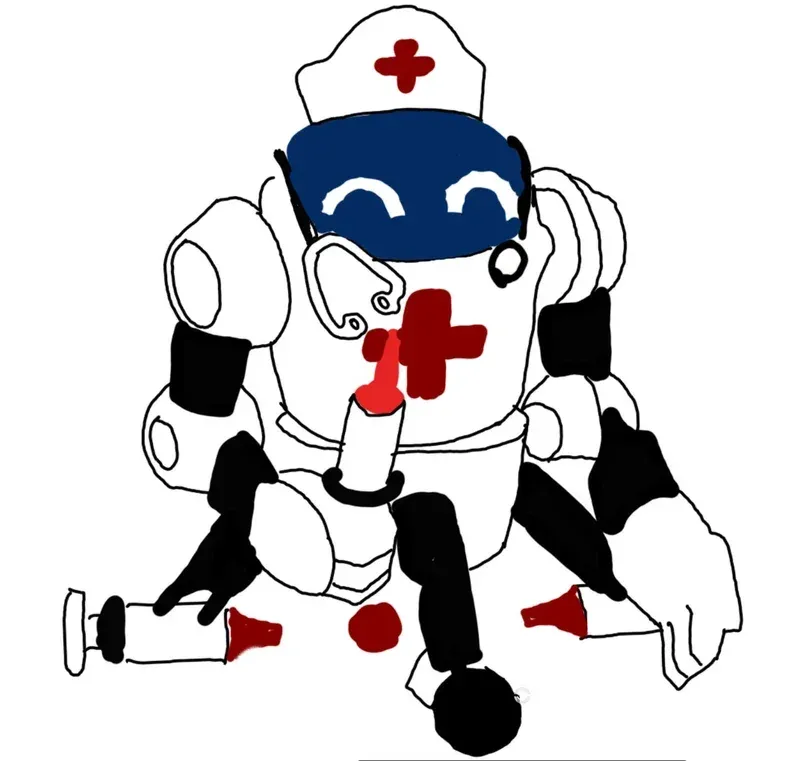
Can Robots Care?
Science & Technology Editor Anastazja Duda, LVI, explores the rise of robot nurses and therapists.

Anastazja Duda
Science & Technology Editor
Artwork by William Croft
Senior 9
Around the world, most prominently in Japan, hospitals are introducing a new type of staff member: robot nurses. In Japan, where almost one third of the population is aged 65 or over, hospitals and care homes have increasingly turned to robotic assistance to support a shrinking healthcare workforce.
The efficiency of these mechanical caregivers is incredible as they are quickly stepping into roles which were once deemed exclusively human. Their rise is fuelled by their demand; intense staff shortages, ageing populations and the increasing complexity of patient care have made healthcare systems ask for support, wherever it is found.
As of this moment, the most reliable and tireless hand could just be made of metal rather than flesh, but should it be?
For nurses working double shifts and patients waiting longer for care, robot nurses have emerged as a technological support rather than a replacement. They can deliver medication with a high level of accuracy, transport and care for patients properly and patrol the use of supplies. For instance, TUG autonomous robots are being used in hospitals across the US and Europe for medicine transportation, transporting meals and supplies and reducing the physical strain placed on nurses during long shifts.
Unlike human staff, they do not experience fatigue, carry disease or require the occasional break during a long, draining shift. Research into nurse burnout highlights long shifts and emotional exhaustion, making technological assistance appealing, but an insufficient fix on its own.
However, while robots may reduce the physical workload, some nurses fear that increased automation could distance them from the relational aspect of care that define their profession.
Yet, their increasingly prevalent presence raises crucial questions specifically about what robots cannot do. Whilst they can simulate the feeling of empathy, they do not actually feel it.
A well-known example is PARO, a therapeutic robot seal used in dementia care, which has been shown to reduce anxiety and loneliness but cannot form genuine emotional understanding. Their emotional regulation is programmed into their brain, rather than being truly felt, which in turn means that their reassuring tones and comforting words do not have the intentions that would come from a real human interaction.
A robot may sense stress in a patient’s voice, but it cannot really grasp fear, grief or uncertainty. For a patient facing serious illness, being understood can be just as important as how they are treated, something that an algorithm cannot fully imitate.
Therapy doesn’t depend only on techniques, but on shared emotional space, one built through trust, vulnerability and mutual understanding. This emotional hole provided by these robots grows as hospitals start to integrate robot therapists into mental-health settings. Much of healthcare is heavily reliant on emotional labour comforting anxious patients, responding to grief and building trust and a patient doctor relationship - tasks that remain uniquely human. The limitations become even more apparent when robots are introduced into mental health care.
Robot therapists are increasingly becoming popular for offering regulated breathing tricks, cognitive prompts, or guided, supported check-ins. They create a continuous, opinion-free zone that some patients find relaxing and comforting. Due to their efficiency, in parts of Taiwan and China, AI-driven therapy systems have been trialed in response to limited access in mental-health professionals and the stigma surrounding traditional therapy. But, just like their nursing counterparts, they can’t give the much needed, emotionally grounded connection that human therapists offer. The only possible responses a robot could provide are polished and merely programmed, lacking the relatability a human could offer.
Robot nurses and robot therapists continue to change healthcare, impacting it in both complex and slightly promising manners. They bring efficiency, comfort, safety and consistency, but they also challenge us all to carefully ponder about the irreplaceability of the human touch.
When used thoughtfully, robots can enhance care delivery, but only when guided by human judgement and ethical oversight. While robots may be transforming the mechanics of healthcare, the heart of care remains human.
Introducing robots into care settings also raises ethical questions about dignity, consent, and the risk of reducing patients to simply data points rather than true individuals. They can assist in healing, but cannot fully replace the compassion, judgement and emotional presence that define truly humane medicine.
Their future in this industry doesn’t just depend on what they can do, but on how wisely and ethically we choose to use them. But, as they become more integrated in hospital and clinics, are they genuinely transforming the healthcare industry for the better, or should we ultimately rely on human professionals to claim back those roles?